Pomellato at the Palais de Tokyo: the making of a revolutionary jeweler
Houses
|
June 26, 2026
Pomellato at the Palais de Tokyo: the making of a revolutionary jeweler
In 1967, when jewelry was still reserved for rare occasions and bound by rigid codes, Pomellato founder Pino Rabolini reimagined it as, instead, freedom. Nearly sixty years later, Pomellato remains among the industry's most radical voices, a legacy brought to life in a landmark exhibition at the Palais de Tokyo, in Paris. Through archival photography, iconic collections, and contemporary creations, "Le Joaillier Révolutionnaire" traces the House's five defining revolutions: in craftsmanship, color, style, image, and the representation of women.
From the outset, Rabolini's vision was clear: jewelry should be bold, joyful, and intimately tied to the individuality of the person wearing it – created for a new generation of women claiming greater independence, and designed to move with them.
In the decades since, the House has continued to challenge convention, redefining not only what jewelry can look like, but what it can represent when chosen by women for themselves.
“Pomellato was born in an era of profound transformation, one in which women claimed greater freedom, independence, and visibility. Pomellato pioneered an equally transformative vision of jewelry: refined, sensual, and unmistakably contemporary.”


Link by link – the chain as creative signature
Raised in a Milanese goldsmithing family renowned for chain making, Rabolini drew on this heritage to elevate the chain from a purely functional element into a creative statement in its own right.
From Ricciolo (1968), Catena Spiga (1987), Intreccio (1983) and Tre Ori (1993), to the first Gourmette bracelet (1967), chains are conceived as supple and tactile, designed to flow with the body. Presented alongside original sketches and archival images, the creations on display reveal the expertise and craftsmanship that underpin their apparent simplicity. Each innovation—plaques that lie flat against the neck, seamless mechanisms, and sculptural forms that conceal clasps entirely—places comfort and movement over display.


In Catene (2021), one of the House’s most recognizable contemporary collections, hand-finished links achieve a near-liquid fluidity – and in select pieces, gold all but disappears beneath a dense pavé of stones, the House’s signature irregular setting that renders the metal almost invisible.
Color as emotional language
Moving through the space, visitors discover a world of colorful jewels chosen not only for rarity or value, but rather for chromatic depth, tactility, and emotional resonance. This is the Pomellato “Free Gems” philosophy: a bold challenge to traditional hierarchies that finds beauty beyond convention.
This philosophy lives in daring cuts and contrasts, unexpected stones—rubellite, peridot, aquamarine, labradorite, topaz—and in innovative settings that turn color into a vibrant language. In heritage collections such as Mosaico (1997-1999), Mora (1996-1997), Rugiada (1999), Griffe (1995) and Caramelle (2004), griffes are transformed from functional supports into striking design features, cabochons are flooded with light through generous open backs, and pavés are laid in intentionally irregular rhythms. In Bisanzio (1993), flush setting frees stones from visible structures – as in Lago (2001), where the gem becomes a luminous drop of color nestled within sculptural gold.


And in the Nudo ring (2001), a gemstone with a patented cut—featuring 57 asymmetrical facets and secured through an invisible setting—appears to float above the finger in pure, saturated color – an iconic design since reinterpreted across a range of sizes and hues.
In form, too, Pomellato frees savoir-faire from tradition, treating jewelry as wearable sculpture: ample, lavish volumes inspired by the Milanese spirit – at once elegant and architectural, bold but precise.
Spirale (1967) earrings explore geometric shapes; in the Gemelle (1971) rigid necklaces, white and yellow gold meet in continuous undulating lines; the Tubolare (1999) necklace and bracelet, though round and sculptural in appearance, lie flat against the skin.
Iconica (2017) with its rounded gold volumes, carries forward this Milanese sensibility, while Pentagoni (2025) expresses it through sensual forms that shift in scale and angle. And rings—symmetrical or irregular, domed or multi-wrap—reinterpret the 1970s gold band archetype as objects of desire made to be combined, stacked, and seen.


Gemelle necklace (1971)
Displayed alongside the imagery they inspired, these pieces reveal an intimate connection between object and wearer that is one of the show's defining themes.
Pomellato through the lens
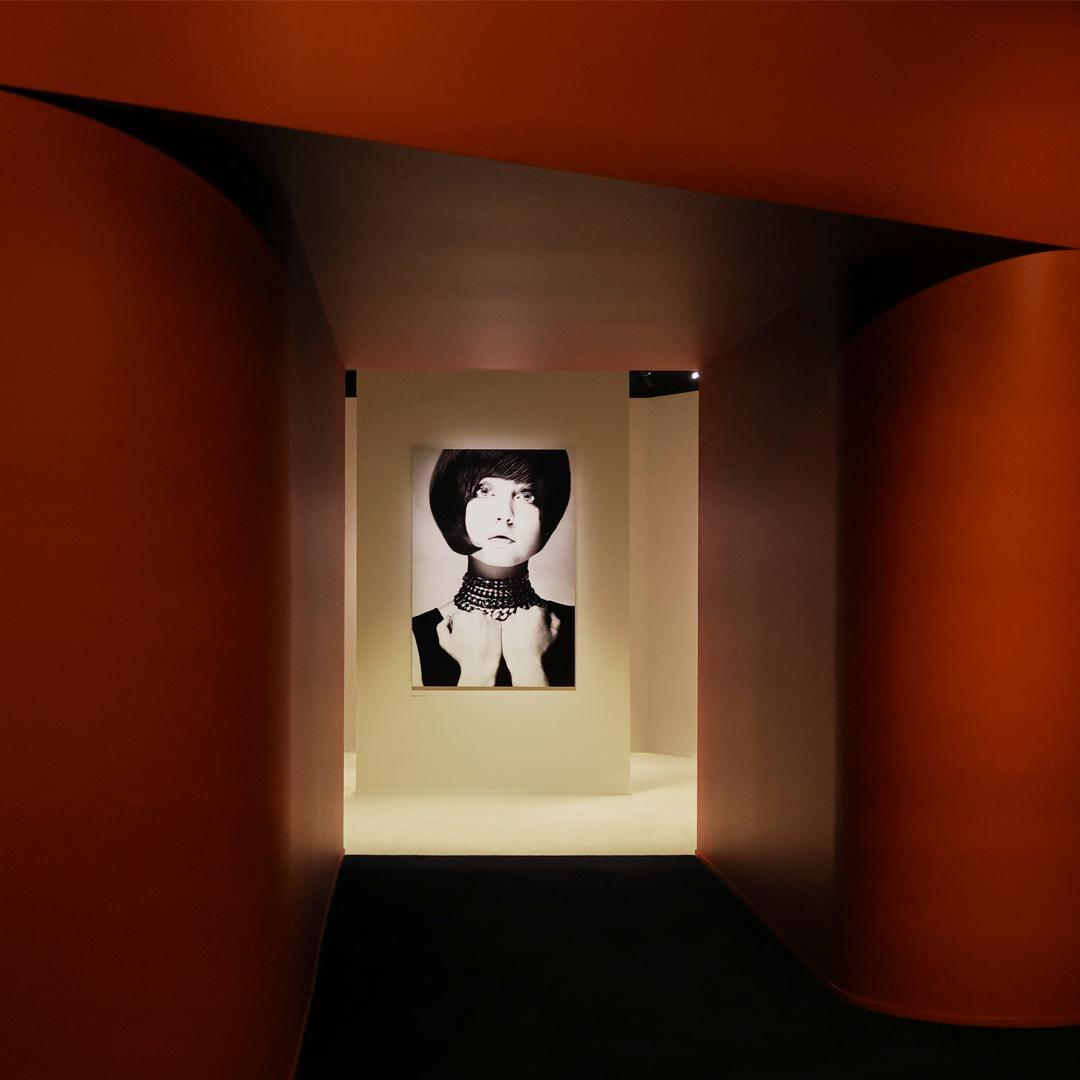
As one of the first jewelry houses to recognize that image could be as radical as design itself, Pomellato entrusted its campaigns to the most influential photographers of the late twentieth century, building in the process a photographic archive with few equivalents in the world of jewelry advertising. It began with the 1971 Gemelle campaign, when Gian Paolo Barbieri framed the Gemelle chokers in a tightly composed double portrait that broke with the static conventions of jewelry advertising. In the 1980s, Helmut Newton’s powerful, high‑contrast black‑and‑white images made Pomellato chains and bracelets part of bold, cinematic scenes, transforming campaigns into visual manifestos. Beyond simply displaying jewelry, these campaigns increasingly foregrounded the women themselves. In Herb Ritts's 1990 campaign for example, bodies covered in clay—evoking ancient statuary—are adorned with polished jewels, the two treated as parallel, inseparable, sculptural forms. At the Palais de Tokyo, these images take their place as works of art in their own right, restoring the original ambition of campaigns always intended as far more than product photography.
The Pomellato woman: always a protagonist
By the 1990s, Pomellato visuals had turned decisively toward character: intimate, emotionally charged portraits that reveal the strength and individuality of the Pomellato woman.
Snowdon’s intimate framings, Javier Vallhonrat’s images of female defiance, and Michel Comte’s documentary-style portraits of Geraldine Chaplin and Catherine Deneuve, among others, shifted the focus from how a woman looked wearing jewelry to who she was – never a muse, always a protagonist.
This perspective forms the through-line across all Pomellato revolutions. From Pino Rabolini's founding conviction to Pomellato for Women, the advocacy platform launched in 2017 dedicated to gender equality and the fight against gender-based violence: each revolution inspired by, created for, and dedicated to women.


That Le Joaillier Révolutionnaire finds its home at the Palais de Tokyo, a space where fashion, art, and ideas converge, is fitting; that it opens alongside Pomellato Stile Libero, the House’s new High Jewelry collection, even more so.
“Pomellato Stile Libero is a mindset – the freedom to move instinctively, to embrace the courage to blend skills and mastery. It is creativity expressed without fear: refined, liberated, and touched by a quiet, thoughtful provocation.”
Pomellato Stile Libero: Legacy Reaffirmed
Spanning 65 creations, the collection embodies the distinctive use of color, sculptural volumes, technical innovation, and exceptional craftsmanship that have long distinguished Pomellato. Among them, Audace reinterprets the emblematic Gourmette chain from the 1972 archives in a modular rose gold construction punctuated by white and brown diamonds; in Drops of Paraíba, 21 pear-shaped Paraíba tourmalines are set into fluid, irregular composition through Pomellato serti libre; and the Arabesque necklace, created in collaboration with French artist Sara Bran, sees rose gold hand-pierced into an openwork architecture of lace-like openings, illuminated by 18 rose-cut and 4,123 brilliant diamonds.


Presented together, the exhibition and new High Jewelry collection are at once a new chapter and a confirmation, revealing the continuity of a vision that has guided the House for nearly six decades: jewelry conceived as an expression of identity, chosen freely by the women who wear it – a vision that has not simply reflected changing attitudes, but helped shape them.
“At Pomellato, every true revolution begins with the courage to challenge conventions and endures in the freedom it makes visible”

Pomellato Stile libero, Attache necklace in the making (2026)
In November 2024 at Shanghai’s Fosun Art Foundation, Pomellato’s first ever exhibition named “Art & Jewelry”, explored half a century of creativity, as reflected through the House’s iconic advertising and flagship designs. Step into this restrospective with Kering Highlights.