A visit to the Ginori Manifattura: the living heritage of Ginori 1735
Houses
|
July 22, 2026
A visit to the Ginori Manifattura: the living heritage of Ginori 1735
Sesto Fiorentino sits just beyond the northern edge of Florence, where the city gives way to industrial flatlands ringed by the Apennine hills. There, a distinctive red-brick water tower bearing the Ginori name in white lettering presides over a vast expanse of low postwar workshops. A siren sounds at eight o’clock and hundreds of artisans file in, many carrying on a family tradition that spans generations. This is the Ginori Manifattura, founded in 1735 and today the oldest continuously operating porcelain manufactory in Italy. In this article, we journey through the workshops, archives, and ateliers of this living heritage site.
A Brief History of Ginori 1735
The story begins fourteen kilometers away, at the Ginori family villa in Doccia, just outside Florence. There, Marquis Carlo Andrea Ginori, a cultivated Florentine patrician fascinated by “white gold,” decided to establish a porcelain factory in a country with no such tradition, imagining a Manifattura capable of standing alongside Europe’s great names.
Across the Alps, Meissen had already mastered hard-paste porcelain, while Sèvres was becoming a benchmark for refined tableware. But where those manufactories favored restraint and muted palettes, the Manifattura di Doccia embraced color: deep blues and greens, citrus tones, exuberant florals and bold pigments, drawing on the Medici legacy of experimental ceramics and Tuscany’s artistic culture.
By the eighteenth century, Ginori porcelain already decorated the tables of Europe’s great residences, associated with a distinctly Florentine elegance – poised between classicism and modernity. Over the following centuries, the Manifattura expanded and transformed, becoming the Richard Ginori ceramic company in the nineteenth century before entering the Kering group in 2013. Yet throughout its evolution, its core production processes have remained fundamentally unchanged.


Three centuries in the making: the production process at the Manifattura
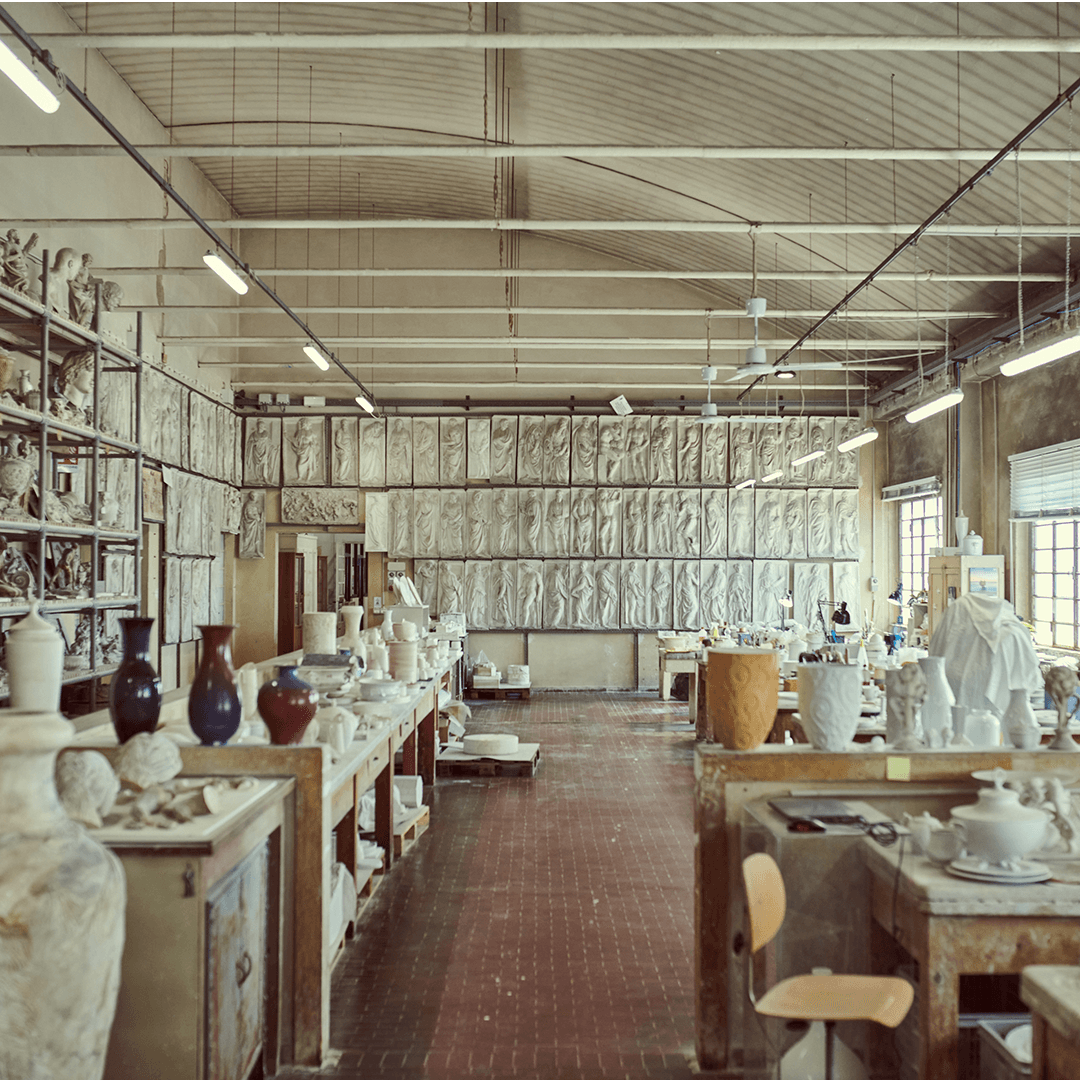
Upstairs in the factory is the modeling department: a room where rows of plaster forms crowd the walls and long workbenches bear the marks of decades of use. Here, master sculptors translate designers’ sketches into three-dimensional plaster molds. The work requires extraordinary precision; porcelain can lose up to twelve percent of its volume during firing, and every measurement must anticipate that shrinkage.

Downstairs, in the slip-casting ateliers, liquid clay—kaolin for plasticity and whiteness, feldspar to enable vitrification, and quartz for durability and density—is poured into those molds and left to rest. As the porous plaster absorbs water, a solid layer gradually forms against the mold's inner walls. When ready, the mold opens to reveal the crudo: the raw porcelain piece, soft and matte.
Handles, knobs, spouts and other details are then added by hand, while blades and sponges smooth away imperfections before the first bisque firing at around 1,000 degrees Celsius, which hardens the clay body.

Glazing follows. Each piece is dipped into a suspension of water and quartz before a second firing at 1,400 degrees – a process that vitrifies the surface, eliminates porosity, and creates that defining hard, white, translucent finish. If the piece is to be decorated—and many are—a third firing is required to fix colors, metals and motifs forever into the glaze.
The art of the hand
The painting atelier, the Pittoria, is the quietest space in the Manifattura, its silence interrupted only by the steady rhythm of brushes on porcelain.
Here, some artisans specialize in freehand gold lining: the fine thread of metal tracing the rim of a plate or the lip of a cup, so personal in its weight and curvature that colleagues can recognize one another’s work at a glance.
Others apply decals—printed sheets bearing decorative motifs—or work with the airbrush, building up tonal gradations that require a steady hand and a trained eye. For the most exclusive collections, hand-painting follows the spolvero method, inherited from Renaissance fresco painting, in which a perforated cartoon transfers the design onto the porcelain before brushwork begins.


Just one piece of porcelain can require six to eight hours, pass through the hands of five to eight artisans, and spend more than eight days in the Manifattura from first casting to final inspection – where only flawless objects make it, ultimately, to the table.
Reinvention without severance
The Voltone Archive: Three Centuries of Plaster Molds
Beyond a corridor off the upper floor, past the modeling department, lies the Voltone. The shelves in this vaulted gallery rise to five meters, holding hundreds of thousands of original plaster molds – the accumulated record of nearly three centuries of production, from Baroque sculptures and classical reliefs to every tableware collection Ginori has ever produced.

This is the House's working archive, a resource designers and production teams consult to revisit historical pieces, identify precedents, and understand not only what the Manifattura has made, but what it remains capable of making. That approach has long defined Ginori’s philosophy: fidelity to heritage and freedom in reinvention – and an openness to outside voices fluent in both.
The Design Department: Where Tradition Meets Contemporary Vision
In this spirit, Gio Ponti became artistic director in 1923, introducing the geometric severity of Labirinto and helping bring the Manifattura to international prominence, notably through a Grand Prix at the 1925 Paris Exposition. In the postwar years, Giovanni Gariboldi continued this trajectory, and his Colonna collection—modular, stackable and radically modern—won Italy’s first Compasso d’Oro in 1954.


More recently, British designer Luke Edward Hall created Il Viaggio di Nettuno, whose vibrant Greco-Roman mythological imagery leverages the full repertoire of the Pittoria’s techniques, while projects like Ginori Domus, Ginori Arte or more recently, in 2026, Officina Ultra, explore new relationships between light, shadow, volume and interior space, extending porcelain into furniture, lighting and home fragrance.
A tradition in transmission: preserving Italian craft excellence
On leaving, the path traces back through the Pittoria's quiet concentration, to the modeling benches still dusted with plaster, past the Voltone's archive of molds, down the stairs to the ground floor—slip-casting ateliers, glazing baths, kilns—then to the courtyard, the water tower overhead, as the day comes to a close.
This steady rhythm that lives at the Ginori Manifattura moves through the work itself: from liquid to solid, from white to color, from past to future. And tomorrow morning at eight o'clock, when the siren sounds and artisans cross the threshold in Sesto Fiorentino, it will begin again. Three centuries of porcelain savoir-faire, preserved as living practice, passed on by hands that learned from other hands.